
The challenge:
The defined sustainability goals requires all sectors to reduce greenhouse gas emissions. Biotechnological production processes offer to use renewable feedstocks and are expected to drive the transition to a sustainable, biobased economy with a lower to zero CO2 footprint. Nevertheless, today’s bioprocesses mostly rely on first- or second-generation feedstocks, which are rich in sugars as these are the preferred substrates of current industrial microorganisms (Wendisch et al. 2016, Straathof et al. 2019). Typically, CO2 is released during such aerobic or anaerobic processes, originating from an imbalance in the degree of reduction or energy requirements of the product pathway.
Our solution:
Establishment of CO2-free production of fine chemicals using methanol as a co-substrate and electron ”booster”. On the one hand, energy or redox equivalents will be balanced by feeding calculated amounts of methanol.
Why methanol? For the future it is expected that excess renewable energy will be available to generate CO2-derived, reduced carbon substrates at scale. Methanol can be obtained from electrochemical reduction of CO2, or synthesis from hydrogen gas and CO2 (Guil-Lopez et al. 2019). It is also well soluble, pH neutral substrate, and industrially relevant hosts have a high tolerance to this alcohol.
What we do in the lab and desk:
The project is carried out in collaboration with the Division of Biotechnology of the Institute of Bio- and Geosciences (IBG) at Forschungszentrum Jülich GmbH and the Leibniz Institute for Natural Product Research and Infection Biology – Hans Knöll Institute (L-HKI).
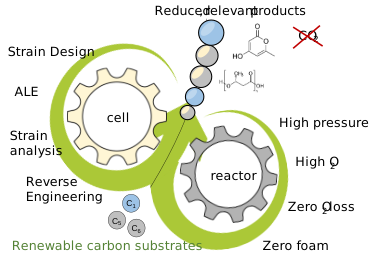
At FAU we on the one hand perform dry-lab (desk) work. We apply constraint-based in silico modelling approaches, especially Flux Balance Analysis and thermodynamic optimization to predict feasible metabolic routes, predict yields, and energy efficiency. These calculations are also useful for the project partners to assist in the design of genetically engineered strains. Kinetic modelling will be applied to design (dynamic) feeding strategies for balancing between growth and product formation.
On the other hand, experiments are performed and better understand the metabolic phenotypes. The genetically engineered methylotrophic strains of Corynebacterium glutamicum are cultivated in bioreactors under controlled conditions. To obtain insights, high-resolution metabolomics and proteomics are applied. These measurements help to identify metabolic bottlenecks and performance-limiting factors.
The combined modeling and experimental approaches aim at establishing robust microbial production systems for sustainable, net-zero CO₂ biomanufacturing.
Get involved:
We welcome applications from students interested in completing an internship, Bachelor’s thesis, or Master’s thesis with our group. If you would like to work with us, please send your application to davide.calzetti@fau.de, including your CV and a brief motivation letter.
Davide Calzetti
Wissenschaftliche Mitarbeitende
Kontakt
References:
Wendisch, V. F., L. F. Brito, M. Gil Lopez, G. Hennig, J. Pfeifenschneider, E. Sgobba and K. H. Veldmann (2016). „The flexible feedstock concept in Industrial Biotechnology: Metabolic engineering of Escherichia coli, Corynebacterium glutamicum, Pseudomonas, Bacillus and yeast strains for access to alternative carbon sources.“ J Biotechnol 234: 139–157.
Straathof, A. J. J., S. A. Wahl, K. R. Benjamin, R. Takors, N. Wierckx and H. J. Noorman (2019). „Grand Research Challenges for Sustainable Industrial Biotechnology.“ Trends Biotechnol 37(10): 1042–1050.
Guil-Lopez, R., N. Mota, J. Llorente, E. Millan, B. Pawelec, J. L. G. Fierro and R. M. Navarro (2019). „Methanol Synthesis from CO(2): A Review of the Latest Developments in Heterogeneous Catalysis.“ Materials (Basel) 12(23).